The Structure, Function and Evolution of Biological Networks
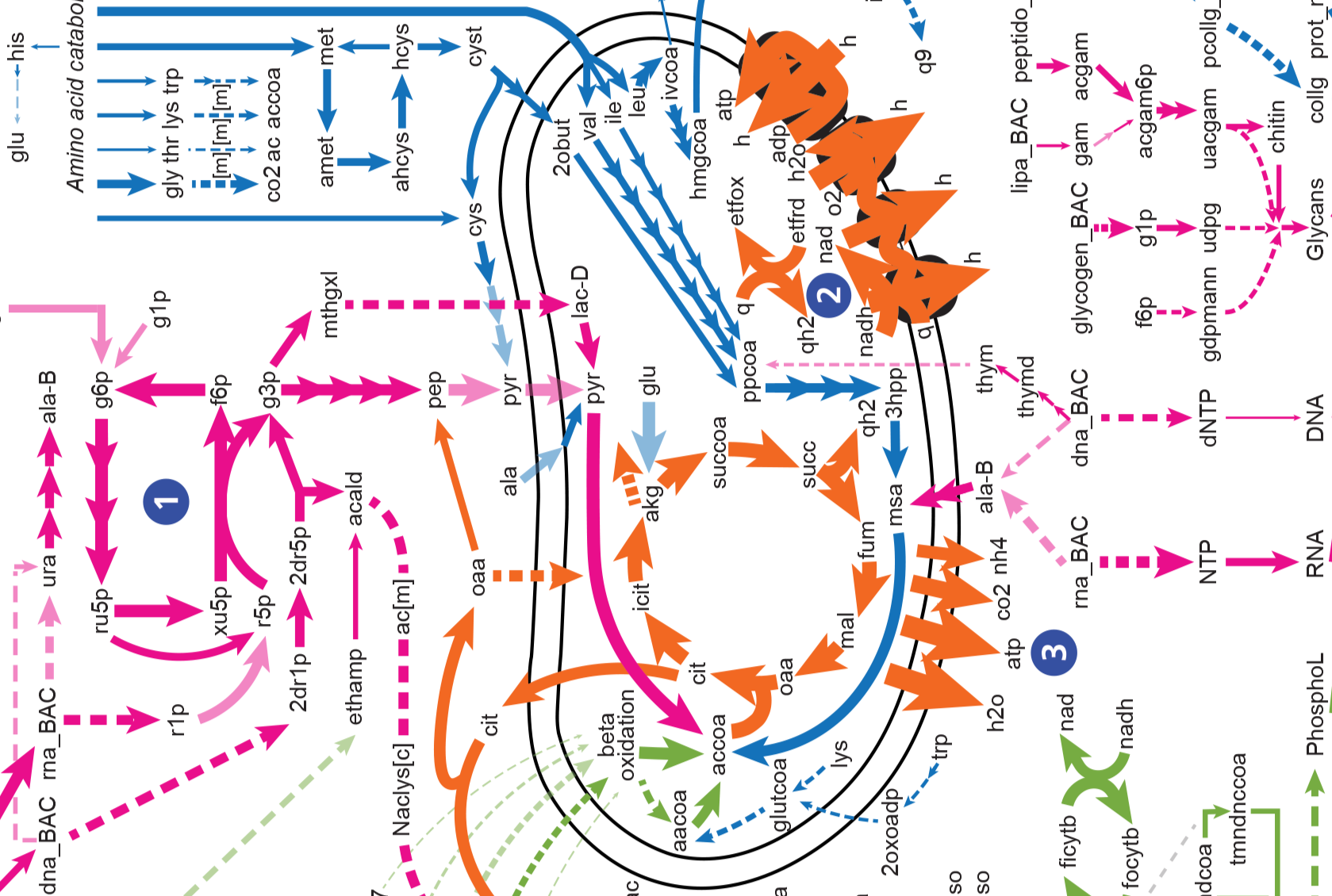
Metabolic networks provide building blocks and energy to support organism development, growth, wound healing, homeostasis. These networks are dynamic and fluctuate in response to nutritional, environmental and therapeutic inputs. Therefore, the tight regulation of these networks is vital to organismal fitness. In the Walhout lab we aim to understand how metabolic networks are organized and regulated, how their organization enables function, and how these networks evolve. We are particularly interested in the communication between metabolic and gene regulatory networks and ask important questions at both broad systems-level as well as deep mechanistic levels to understand these biological processes. Our model organism of choice is the roundworm Caenorhabditis elegans. These worms are highly adaptable, easy to manipulate, and have many analogs in human genetics. We have made significant advances to understand the composition and tissue specific functions of metabolic networks using various experimental and computational methods such as large-scale genetic screens, transcriptomics, metabolomics and transcription factor binding assays, as well as flux balance analysis, nested effects modeling and statistics. However, there is still more work to done. We welcome you to join us on our journey!

Meet the Team
-
![]()
Marian Walhout, PhD
Professor
-
![]()
Lynn NeJaime
Assistant to Dr. Walhout
-
![]()
L. Safak Yilmaz, PhD
Associate Professor
-
![]()
Yuzhi Chen, PhD
Post-doctoral Fellow
-
![]()
Gabrielle Giese, PhD
Senior Research Scientist
-
![]()
Katarzyna (Kasia) Hencel
Post-doctoral Fellow
-
![]()
Zeynep Mirza, PhD
Post-doctoral Fellow
-
![]()
Maximilian Mosbacher, PhD
Post-doctoral Fellow
-
![picture of Matthew Pollard]()
Matthew Pollard, PhD
Post-doctoral Fellow
-
![]()
Tanatcha Sanguanphun, PhD
Post-doctoral Fellow
-
![]()
Evelien Simonis, MS
Graduate Student
-
![]()
Daniella Wilmot
Research Associate
-
![]()
YuChun (Penny) Wu, PhD
Post-doctoral Fellow
-
![]()
Ann Xu
Research Associate